Infrastructure-led Charging Architecture

11kV Direct HV Charging.

An infrastructure-led architecture for high-power fleet and commercial projects. Designed for the projects where site economics and deployment practicality matter as much as the charger specification.

Infrastructure cost
Up to 35% reduction in project engineering cost vs conventional site-built infrastructure
Programme speed
Delivery timelines up to two-thirds shorter than traditional charging station builds
1000V DC platform
Ultra-high-power output on a 1000 V DC platform — future-ready for next-generation vehicles
Simplified topology
Fewer conversion stages versus traditional multi-cabinet charging station architecture
Energy integration
Common DC bus supports PV, ESS, V2G, and microgrid integration from day one

The most important decisions are often not about charger hardware alone.

In larger charging projects, decisions about how the wider site infrastructure is configured, how the project will be delivered, and whether the charging model makes commercial sense over time — these often have more impact on project value than the choice of charger unit.

Neutron's 11kV HV direct charging approach is designed for exactly that kind of conversation — helping customers evaluate charging infrastructure in terms of site practicality, project economics, deployment logic and long-term value.

A wider infrastructure decision.

11kV direct charging is most valuable when considered as part of the complete site infrastructure review — not as a standalone equipment decision.

Infrastructure cost

Direct HV connection removes multiple transformation and distribution stages — reducing the number of major cost items in a conventional charging infrastructure build.

Implementation route

Factory-assembled, lift-in-place installation. Lower on-site assembly complexity, fewer power cable runs, and reduced civil works versus conventional station-built approaches.

Site suitability

Most applicable where a high-voltage grid connection already exists or is planned — logistics parks, bus depots, industrial sites, motorway charging locations, and port facilities.

Operational fit

Direct HV architecture simplifies the operational asset structure — fewer metering points, simpler protection coordination, and cleaner integration with site energy management systems.

Future scalability

The common DC bus architecture allows additional charging terminals, ESS modules, and renewable generation to be added to the same infrastructure platform as demand grows.

Long-term project value

An infrastructure-led review can provide a clearer view of long-term project economics — particularly for large-scale projects where infrastructure cost and programme risk are significant variables.
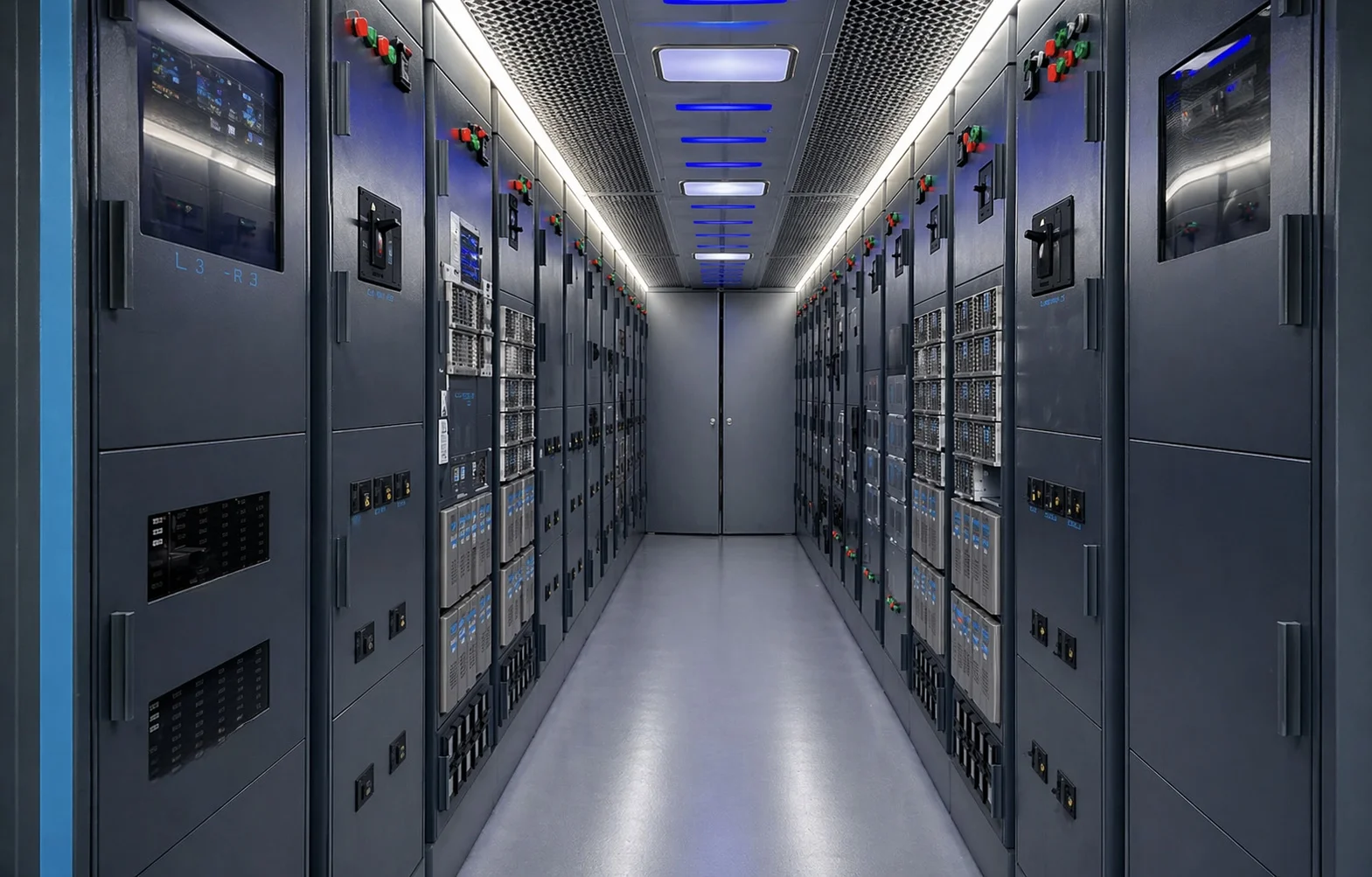
Integrated high-voltage
charging architecture.

A unified system that brings together high-voltage equipment, transformer, LV distribution, AC/DC conversion, and DC charging terminals within a single factory-assembled solution.

HV Switchgear
11kV protection and isolation. Factory-integrated and type-tested for direct grid connection.
Transformer
11kV / LV step-down, sized to site demand. Integrated within the prefabricated enclosure.
AC/DC Conversion
High-efficiency rectifier stage supplying the 1000 V DC common bus from LV AC output.
DC Bus — 1000 V
Common 1000 V DC platform shared across all terminals, ESS, PV, and V2G connections.
DC Terminal × 1 to N
Scalable CCS2 vehicle charging outputs. Each terminal draws directly from the shared DC bus.
EMS & CMS Layer
Neutron Grid EMS for energy dispatch and Electron CMS for charge session management, both connected to the DC bus.
Integrated Power Unit
1.25MW
11kV 3-Phase AC Input
HV · Transformer · LV DC · All integrated in one enclosure
DC Output
50–1000 V
Terminals
Up to 30
Installation
Single crane lift
HV Cabling
Minimal

Lift-in-place.
Not built on site.

By integrating all major system components in a controlled factory environment, Neutron shifts complexity away from the construction site — into a managed process.

  • HV cabinet, transformer, inverter, and DC terminals pre-assembled
  • Factory acceptance testing (FAT) before dispatch
  • Lift-in-place installation — no on-site equipment assembly
  • Substantially reduced civil works versus conventional approaches
Neutron HV Direct Integrated Power Unit

A more efficient route to deployment.

Shifting more integration work into a factory environment can support meaningful reductions in engineering cost and programme duration, depending on site conditions, scope, and comparison baseline.

Engineering Cost
Neutron 11kV HV Direct Relative cost
Conventional site-built Baseline
Programme Duration
Neutron 11kV HV Direct Relative duration
Conventional site-built Baseline

Indicative comparison. Actual savings depend on site conditions, scope, and comparison baseline.

35%
Reduction in project
engineering cost
2 3
Shorter programme timeline
vs conventional site-builds

Designed for broader
energy-system thinking.

The common DC bus at the core of Neutron's HV direct charging system creates a natural integration point for wider energy assets — making the 11kV conversation relevant beyond charging power alone.

Renewable integration

PV and wind generation can connect directly to the common DC bus — enabling direct use of renewable generation for charging without additional AC/DC conversion stages.

Energy storage integration

ESS connects on the DC bus — enabling peak shaving, demand charge reduction, and grid service participation. Works with Neutron Power Hub and Power Plant container systems.

V2G system integration

The DC bus architecture is compatible with bidirectional DC charging. Vehicles can export energy back to the site or grid — enabling V2G revenue streams managed by Neutron Grid EMS.

DC microgrid architecture

The system is inherently compatible with DC microgrid design — providing a flexible backbone for integrated site energy management, islanding, and demand response at high power levels.

Where 11kV HV Direct is most relevant.

11kV direct charging is best suited to infrastructure-led projects with specific characteristics that make the architecture's advantages most commercially meaningful.

Most relevant when:

  • Charging demand is high — multiple high-power bays needed simultaneously
  • A high-voltage grid connection already exists or is being commissioned
  • The site needs to expand charging capacity over time on a common infrastructure
  • Project economics favour lower infrastructure cost over simpler specification
  • Programme delivery speed is a critical project constraint
  • Energy integration (PV, ESS, V2G) is part of the longer-term site plan

Best-suited project types:

Bus & Coach Depots
High-power, high-volume fleet charging
Logistics Parks
LCV & HGV fleet electrification
Motorway Charging Hubs
Ultra-rapid public charging at scale
Industrial Sites
Existing HV connection, high demand
Ports & Freight
Heavy-duty vehicles, terminal charging
Energy Hubs
Charging + ESS + PV integrated sites

Ready to discuss
an 11kV project?

Our engineering team will assess your site and present an infrastructure model matched to your project's requirements.

Request Engineering Consultation View Fleet DC Products

Let's talk.

Product enquiries, project scoping, and partnership opportunities. Our engineering team responds within one business day.

Email
info@neutron-systems.com
Address

9 Mallow Street, London, EC1Y 8RQ
United Kingdom

Follow us