Solar · Storage · V2G · EMS

Integrated Microgrid.

Solar generation, intelligent battery storage, V2G, and AI-driven dispatch — unified in one site-native system that earns its keep from day one.

Every component,
one connected system.

Generation, storage, charging, and grid services operate in concert under the Electron EMS. The system optimises dispatch in real time against live tariff data, forecast solar yield, and fleet charging schedules.
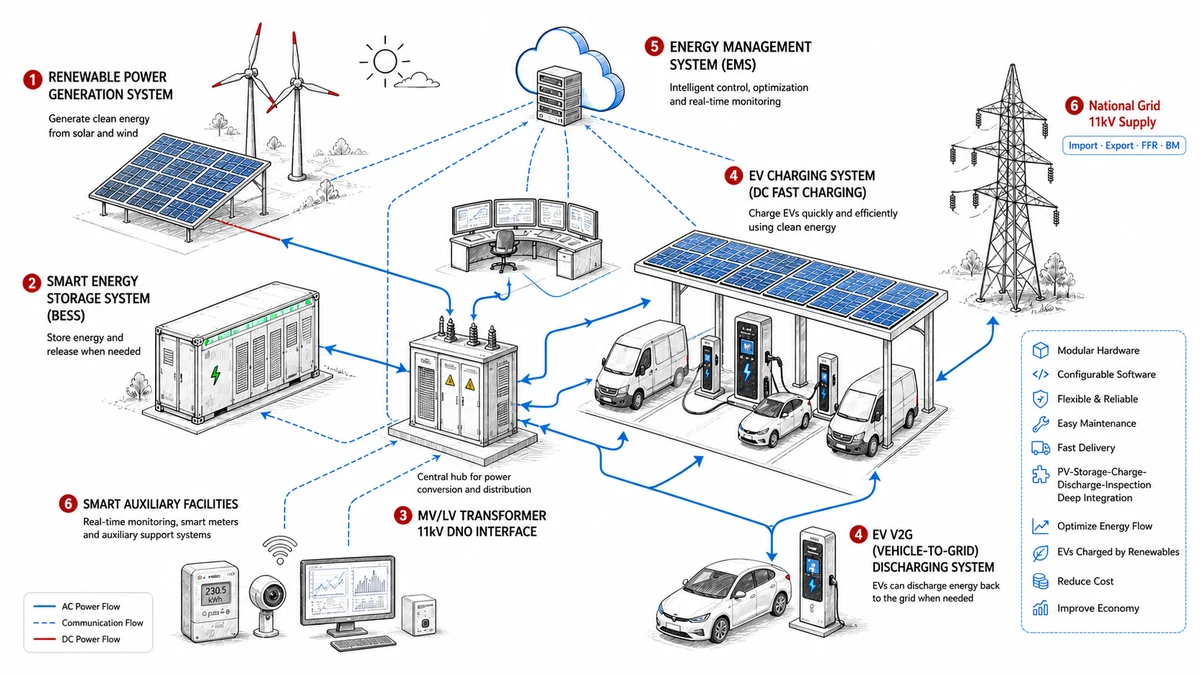
Neutron Microgrid system architecture diagram showing Renewable Power Generation, Smart Energy Storage BESS, MV/LV Transformer 11kV DNO Interface, DC Fast Charging, V2G discharging, Energy Management System, and National Grid connection

Solar PV panels and a wind turbine generate renewable electricity, feeding into a high-voltage transformer. A Battery Energy Storage System (BESS) stores surplus energy. DC fast chargers deliver up to 1,500 kW for rapid EV charging. A V2G hub enables vehicle-to-grid energy export. Smart AC wallboxes handle residential and workplace charging. The Electron EMS cloud platform monitors and orchestrates dispatch across all subsystems in real time.

System components shown are indicative. Actual configuration is sized per site following a detailed energy audit and DNO consultation.

Six subsystems.
One integrated whole.

Each subsystem is individually capable. Together, they form an energy infrastructure that generates, stores, charges, earns, and self-optimises — continuously.

01 — Generation
Solar PV Array
Bifacial monocrystalline panels mounted on rooftop, carport canopy, or ground array. Inverter-coupled to the AC busbar, with excess generation available for grid export or battery charging.
02 — Storage
Battery Energy Storage
Bidirectional BESS sized to the site's peak shaving, arbitrage, and grid services requirements. Available in second-life EV cell or new lithium-iron-phosphate (LFP) configurations.
03 — Bidirectional Charging
V2G Charging Hub
Vehicle-to-Grid bidirectional charging allows parked fleet EVs to export stored energy to the site or grid during peak tariff periods, effectively turning the fleet into a distributed battery.
04 — Fast Charging
DC Fast Charging
High-power DC dispensers fed from the shared AC busbar. One Master Unit powers multiple satellite terminals — maximising installed charging capacity without proportional grid upgrade cost.
05 — Fleet AC Charging
Smart AC Chargers
Overnight fleet charging on AC. Dynamic load sharing across all ports ensures maximum vehicles are charged by shift start, while demand charges are kept within DNO limit — automatically.
06 — Intelligence
Electron EMS
The AI dispatch engine that coordinates every subsystem. It ingests live tariff signals, weather forecasts, solar yield predictions, fleet departure schedules, and grid service windows — then optimises dispatch continuously.

Six operating modes.
Seamless transitions.

The Electron EMS selects and blends operating modes in real time. No manual intervention. The system responds to sunlight, tariff prices, fleet demand, and grid signals autonomously.

Mode 01
Solar Direct Charging
Solar PV EV Chargers
During daylight hours when solar generation matches or exceeds charging demand, EVs charge directly from the array. Zero grid cost, zero carbon. Typical mid-morning to mid-afternoon window.
Mode 02
Solar + Storage Dispatch
Solar PV + Battery EV Chargers
When solar alone is insufficient, the BESS supplements generation to meet charging demand. The EMS calculates the optimal draw from storage based on remaining state-of-charge and forecast solar yield.
Mode 03
Off-Peak Grid Fill
Grid Battery + Fleet
Overnight at off-peak tariff rates (typically 11 pm – 7 am), the EMS charges both the BESS and all fleet vehicles at maximum available rate. The site prepares its full energy buffer before morning peak pricing begins.
Mode 04
Peak Shaving
Battery + Solar PV Site Loads
During peak tariff windows (4–7 pm), the BESS discharges to cover site demand and EV charging. Grid import drops to near zero, avoiding both high unit rates and demand charge penalties.
Mode 05
V2G Grid Export
Fleet EVs + Battery Grid
During Balancing Mechanism or FFR events, parked fleet EVs and the BESS export energy to the grid. Revenue is credited per MWh. Electron EMS only dispatches EVs with sufficient charge to guarantee fleet departure readiness.
Mode 06
Constrained Grid Capacity
Grid
100–400 kW
BESS
~2 MWh
DC Fast
up to 1.5 MW
When the DNO connection is smaller than charging demand, the BESS fills slowly from the grid during idle periods and discharges at up to 1,500 kW on demand. The grid never sees the peak load — eliminating costly HV upgrades and reducing station build cost by up to 60%.
ADVANCED CAPABILITY

MW-class charging from a
constrained grid connection.

Many UK sites face a hard ceiling on their DNO connection — 100 kW, 160 kW, sometimes 400 kW. That ceiling has historically ruled out rapid or ultra-rapid charging entirely. Mode 06 removes that constraint. By treating the on-site BESS as a local power reservoir — charged slowly around the clock, discharged instantly on demand — Neutron can deliver up to 1,500 kW of charging power through a connection a fraction of that size.

10×
charging power vs. grid connection
−60%
station build cost vs. HV upgrade route

No grid upgrade.
No DNO delay.
No compromise.

A conventional EV charging deployment is limited by whatever grid connection the site happens to have. The Neutron Microgrid removes that constraint — combining generation, storage, and intelligent dispatch so the site's effective energy capacity becomes far larger than the physical grid connection.

WITHOUT MICROGRID
Charging capped at grid connection size
DNO upgrade: £100k–£500k+ and 1–3 years
Peak demand charges on every kW imported
No revenue from idle connection capacity
WITH NEUTRON MICROGRID
MW-class charging from a 100–400 kW connection
Deploy in weeks, no DNO application required
BESS absorbs peaks — grid import stays flat
FFR / BM revenue from the same assets
Worked example
A 160 kW DNO connection + 300 kWh BESS + 120 kWp solar can support a peak charging throughput of over 500 kW — with no grid upgrade, no DNO application, deployable today.
effective capacity
multiplier

Four revenue streams.
One system.

A typical Neutron Microgrid deployment on a UK fleet depot generates returns from solar savings, tariff arbitrage, grid services, and EV charging service fees simultaneously. Figures below are indicative for a mid-sized 120 kWp / 300 kWh installation.

Solar Generation Savings
28–35p
per kWh avoided grid cost
at current UK commercial rates
Peak–Valley Arbitrage
15–25p
per kWh spread between
off-peak and peak tariff
Grid Services (FFR / BM)
£5–15
per MWh for frequency
or balancing response

4–8 year ROI
at typical utilisation.

Combined revenue from solar, storage arbitrage, and V2G grid services typically returns capital within four to eight years, depending on site utilisation, tariff structure, and grid services participation. The system continues to generate value for 20+ years.

View ownership & investment models
Carbon Reduction
40–70 tCO₂e / year
Avoided emissions for a 120 kWp solar + 300 kWh BESS system replacing grid import
Demand Charge Reduction
Up to 40%
Reduction in peak demand charges through intelligent load management and BESS peak shaving
Energy Cost Reduction
35–55%
Total energy bill reduction versus unmanaged EV charging at standard commercial tariff

Where the system
performs best.

The integrated microgrid is most cost-effective where EV charging demand, available generation surface, and operational hours align. These four site types consistently show the strongest financial and operational case.

Fleet & Logistics Depots
Overnight charging of vans, trucks, and buses combined with V2G daytime dispatch. High utilisation and large roof areas make fleet depots the highest-returning deployment for the microgrid system.
Industrial & Manufacturing Sites
Large roof areas, consistent daytime load profiles, and high demand charges make industrial sites prime candidates for solar-storage integration. Peak shaving often delivers the fastest return.
Business Parks & Campuses
Multi-tenant business parks benefit from shared microgrid infrastructure amortised across a larger user base. EV charging as an amenity drives occupancy; energy savings are shared with tenants.
Public Sector & Councils
Councils and public bodies operating vehicle fleets benefit from predictable energy costs, carbon reporting for net-zero targets, and the ability to participate in grid flexibility markets without specialist expertise.

Fully delivered.
Zero guesswork.

Neutron designs, supplies, installs, commissions, and supports the full system. One partner, one contract, one point of accountability.

Site Survey & Energy Audit
Detailed analysis of grid connection, solar potential, charging demand, and tariff optimisation opportunity before any commitment.
Full Design & Permitting
G99 application, DNO negotiation, planning permission where required, and structural sign-off for all solar mounting.
Installation & Commissioning
Turnkey civil works, electrical installation by NICEIC-registered engineers, and full system commissioning with witnessed acceptance tests.
Electron EMS Onboarding
Platform configuration, tariff integration, fleet telematics connection, and staff training. Live from day one of commissioning.
Long-term Maintenance
Preventive maintenance schedule, remote monitoring, 7×24 fault response, and annual performance reporting for all system components.
Flexible Ownership Models
Full ownership, CaaS, Equipment Finance, Joint Venture, or PPA — the microgrid can be structured to suit your balance sheet. Zero upfront options available.
Component Deep Dives

Each subsystem explored in detail.

Energy Storage
ESS Products
Home Power Wall, Commercial Power Hub, and grid-scale Power Plant Container — the storage backbone of every microgrid.
Explore ESS →
Software
Platform & EMS
Electron CMS and Grid EMS — real-time dispatch, tariff arbitrage, V2G scheduling, and grid services participation.
Explore Platform →
Charging
Fleet DC Charging
DC terminals and master units that integrate directly into the microgrid — charging from storage, solar, and grid simultaneously.
Explore Fleet →

Start with a
site assessment.

We begin every microgrid project with a no-obligation energy audit — grid connection capacity, solar yield potential, charging demand profile, and tariff optimisation opportunity. Typically completed within two weeks.